
The breed
Louisiana Catahoula Leopard Dog: its history, its temperament, its work and the sports we do with it.
State dog of Louisiana
since 9 July 1979
UKC recognition
1 January 1995
Origin
Louisiana, USA
Two settings
ON and OFF
The exact origin of the Catahoula is unknown, but it most likely descends from crosses between the red wolves living around Native American villages and the dogs of the native peoples. Molossers and sighthounds brought in by Spanish settlers played a large part in shaping the breed, and its bloodline probably also includes the Beauceron (French shepherd dog), linked to the arrival of the French settlers.
The white settlers of Louisiana noticed that the Native Americans used these unusual-looking dogs to take down many kinds of big game, such as deer, lynx, wild boar and bear. The newcomers quickly grew fond of this versatile breed, which is just as good at scenting, tracking and flushing game as at rounding up cattle.
One thing is certain: the Louisiana Catahoula Leopard Dog (LCLD) is a true American, versatile working dog. On 9 July 1979 the Governor of Louisiana officially named this noble breed the state dog of Louisiana. The United Kennel Club recognised the LCLD as a breed on 1 January 1995.

The Catahoula is rather vehement and full of temperament. It can literally summon all of its energy in an instant for the task in front of it. There is of course a difference between males and females in this respect, but it is essentially just as true for the girls. In our experience they have roughly two settings: ON and OFF. Whatever it is about, love, work or dominance, you could say they react VERY strongly to everything. That is also what makes raising them difficult.
The Catahoula is not for everyone! Once we look past their beautiful appearance, this is extremely important to keep in mind. An impressive exterior does not by any means come with an easy temperament.
Early socialisation is essential: the puppy has to get to know the things of the world early on. Interestingly, the herding and driving tendencies typical of the breed show up very early in puppies too: they often nip, bark at, herd, or even pin their littermates by the throat. In some of them the protective instinct also surfaces very early. It is worth bringing these still amusing little moves under control early.
The Catahoula is nevertheless a sensitive soul. In training, consistency, motivation and firmness get results much sooner than forceful methods, which only provoke stubborn resistance!
Later on it is also important to get them used to dogs of the same sex. This is rarely smooth with such a dominant breed. Many people call Catahoulas aggressive; in our view this should not be confused with dominance. With them it is rather the latter, and here too we would stress how important it is to practise self-control and for the pack leader to be stable, so that conflicts are avoided. A well-socialised Catahoula male will in the vast majority of cases not start a fight. He will, however, not hesitate for a moment to defend himself if the situation calls for it.
Shared activities planned for later, sport and work, or dog shows are much easier with a socialised dog.
Its place in the family is simply a fact. Since it is overflowing with love, it will not let you not love it. It may be reserved with strangers at first, but once it warms up, its clownish behaviour returns.
Because of the breed's beauty, many people tend to forget this. The history of the breed shows that its primary job was work. This tendency, instinct, whatever we call it, is still very much alive in every dog, and it demands that we give it the opportunity.
So the Catahoula and work belong together. Whatever the activity, hunting, herding or dog sports, the Catahoula is happy to do it. It is sometimes at odds with obedience tasks, most often because of a lack of self-control and the presence of a much, much more interesting smell. This can of course be taught, and it is recommended for smooth cooperation later on. It helps to keep motivating them while practising this “necessary evil”.
What is it good for? Everything. Of course, the individual dog's personality, traits and build have to be taken into account when choosing a direction. For heavy-boned dogs, for example, frisbee will not be the right choice. But since this is a multi-purpose breed, choosing is not hard. The best sports are the ones that satisfy the hunting instinct and the herding drive: coursing, hog baying, treeing and herding tasks, with cattle being the most suitable. Beyond physical exercise it is very important that the dog can use its brain too. Playful sports: frisbee, flyball. It greatly enjoys tracking and search tasks, and the breed has proven itself as a tracking and search and rescue dog. Its strongly territorial nature also makes it suitable for guard and protection work. A dog with the right personality can also do well as an assistance dog.
It is best to start any training at a dog school. You could say it is compulsory. Once the basics are in place, above all a reliable recall, the fun can begin. The pack leader should be firm and decisive, with a stable and unquestionable place in the pack!
It should be noted that a Catahoula that is not kept busy properly and regularly may develop behaviour problems, and our flat, house and garden will pay the price. If we see this, one thing is certain: it is bored to death.

Work and sport
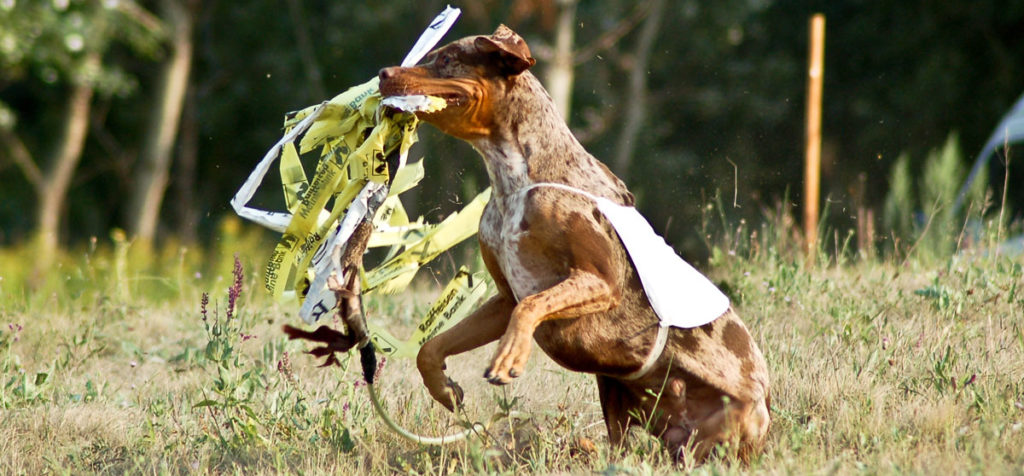
Lure coursing
Lure coursing is a sport that imitates hare hunting. The sight of the moving “game” catches the Catahoula's interest in the blink of an eye, and it sets off in a frantic chase.
Coursing tires the dog out and works it very well. Our goal is a licence for each of our dogs. At competitions the “problem” is rather their thinking: after watching a few runs, they cut the corners. They simply skip the unnecessary parts. They follow the scent of the lure and they can remember the course. So a good placing sometimes slips away, but for them the running and finishing the distance, and for us the feeling of pride, make up for it.
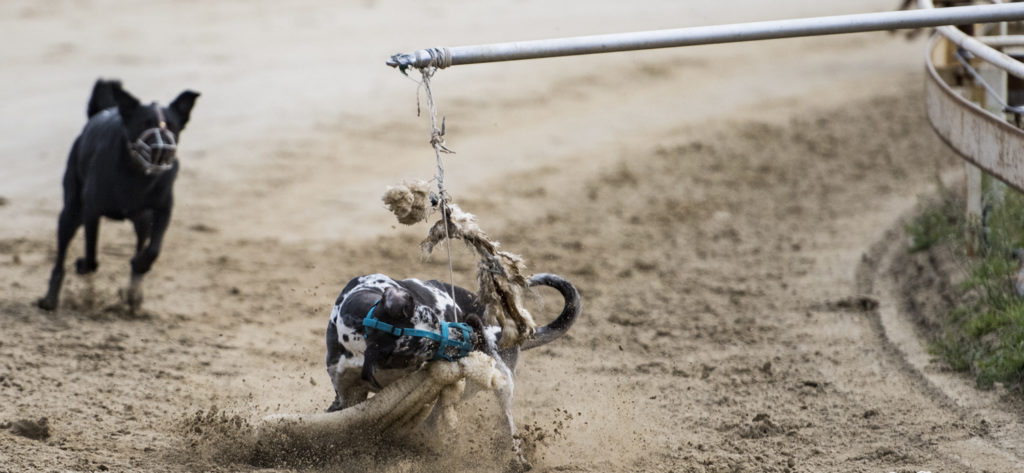
From the box, muzzled, timed
Similar to coursing, but run on a greyhound racing track, also after a lure (hare). It is an excellent training opportunity for hunting dogs too.
Fortunately there is no corner-cutting to worry about here: experienced racers start from the box and must wear a muzzle, so we can follow their progress through the measured times.
A training day like this is pleasantly exhausting for them; when they are not on the track, they can let out their ear-piercingly high “driving” bark all day long.
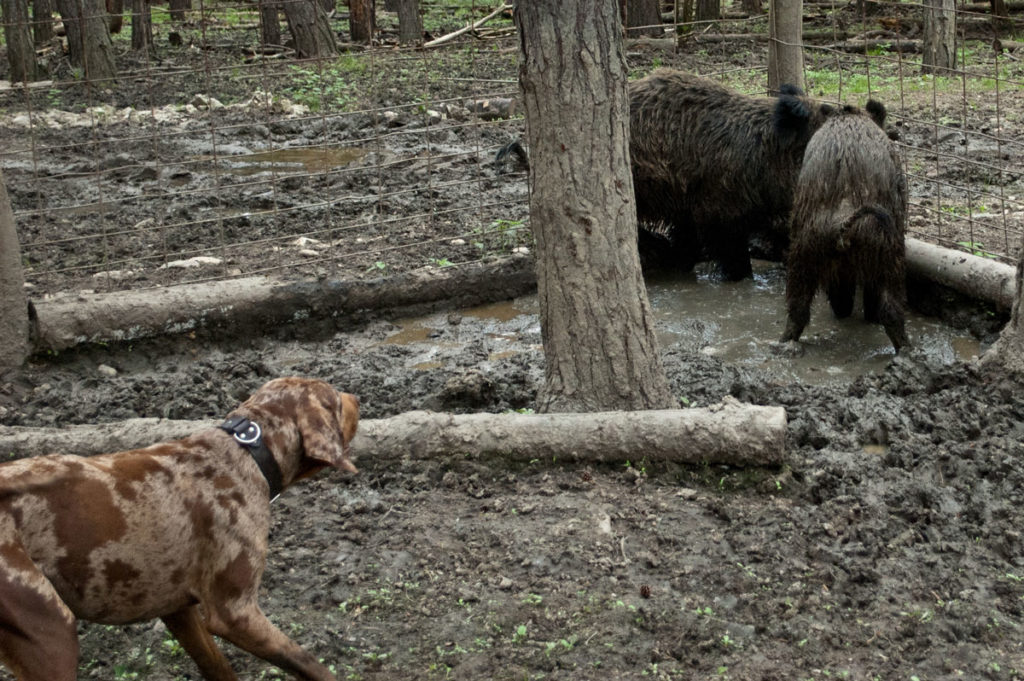
Finds it, flushes it, bays it
Hunters still use many Catahoulas to help on wild boar hunts today. They take them to work in a small pack or even alone: the dog finds and flushes the game, and when it succeeds it holds it at bay without attacking it. Despite its larger size, the Catahoula is perfectly suited to wild boar.
It is best to start practising wild boar work in a hog training garden. Their job is to find, flush, drive and bay the boar. Just as it is written. After all, this is what they were born for.
This is one of Evin's and Egra's real jobs; their courage and vehemence far exceed Logan's. Evin's first wild boar trial was at 4 months, Egra's at 15 months.
We do not plan to take part in live hunts.
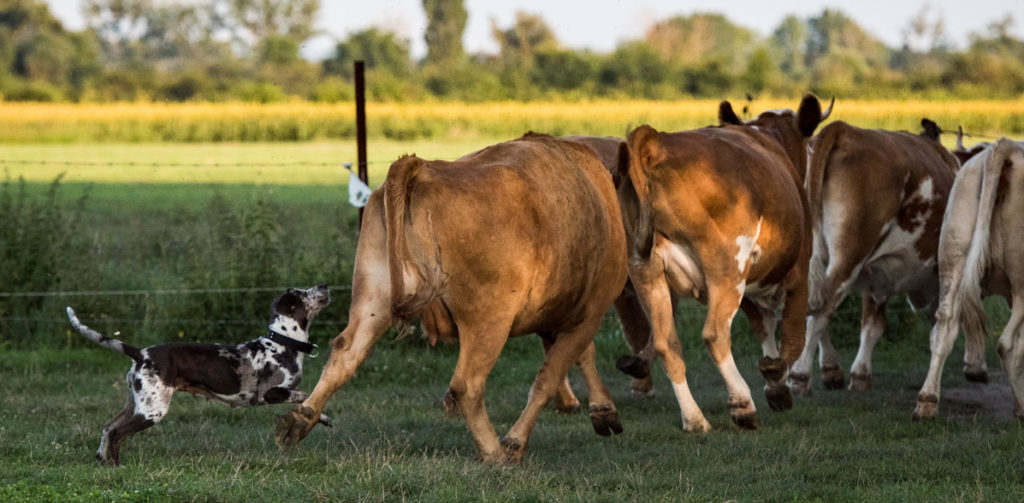
A firm style that does not take no for an answer
Cattle herding is one of the Catahoula's specialities. In its homeland, most Catahoulas kept as working dogs are used for this on farms. Its herding style is firm and does not take no for an answer. Keeping a herd of cattle in check takes a forceful approach, which the Catahoula demonstrates in an exemplary way.
It is also in its element around horses, so it is often kept on horse farms alongside the animals, even as a guard.
Our dogs regularly herd a small herd of cattle. Mostly they help the owner of the cattle with gathering them, moving them to a new pasture and driving them to their night place. If we can rank the tasks, this is the one that suits them best.
Now and then they also help herd a larger flock of sheep, but their herding style is a bit too vehement for sheep. We are still learning and practising this, under expert guidance.
We use cookies to understand what our visitors are interested in. Analytics cookies only run with your consent. You can change this anytime via »Cookie settings« in the footer.